Wastewater Heat Recovery Series Part 1: Turning an Overlooked Energy Stream into Usable Building Energy
/
Wastewater heat recovery is no longer just an interesting idea on the edge of the decarbonization conversation. It is gaining attention as owners, developers, municipalities, and public agencies look for lower-carbon ways to meet some of the most persistent energy demands in buildings: heating and hot water. This series looks at how wastewater heat recovery works, where it tends to make the most sense, and what owners and design teams should think about as they evaluate it as part of a broader decarbonization strategy.
A Recoverable Energy Source
Every day, buildings send wastewater down the drain from showers, lavatories, laundry, commercial kitchens, and suitable process loads. Some of those streams leave the point of use at temperatures that may be suitable for energy recovery, depending on flow rates and project economics.
The strongest applications are usually buildings where enough wastewater is available near a consistent heating load, such as domestic hot water or space heating. In some cases, wastewater heat recovery can also support heat-pump systems that serve heating and cooling needs at the same time.
Mixed sanitary wastewater can still be a useful heat source, but its temperature is less predictable than dedicated warm-water streams because it includes cold-water discharges from toilets, sinks, and other fixtures. For that reason, the recoverable energy depends on both wastewater flow and temperature at the point where the water is collected for heat recovery.
When it displaces a less-efficient or higher-carbon system, wastewater heat recovery can reduce a facility’s purchased energy and associated emissions. The BTUs extracted from the heat source are free, but process requires nuance. Actual savings will depend on several project-specific factors, including heat-pump and auxiliary electricity use, load matching capability, system temperatures, distribution losses, among others (Figure1).
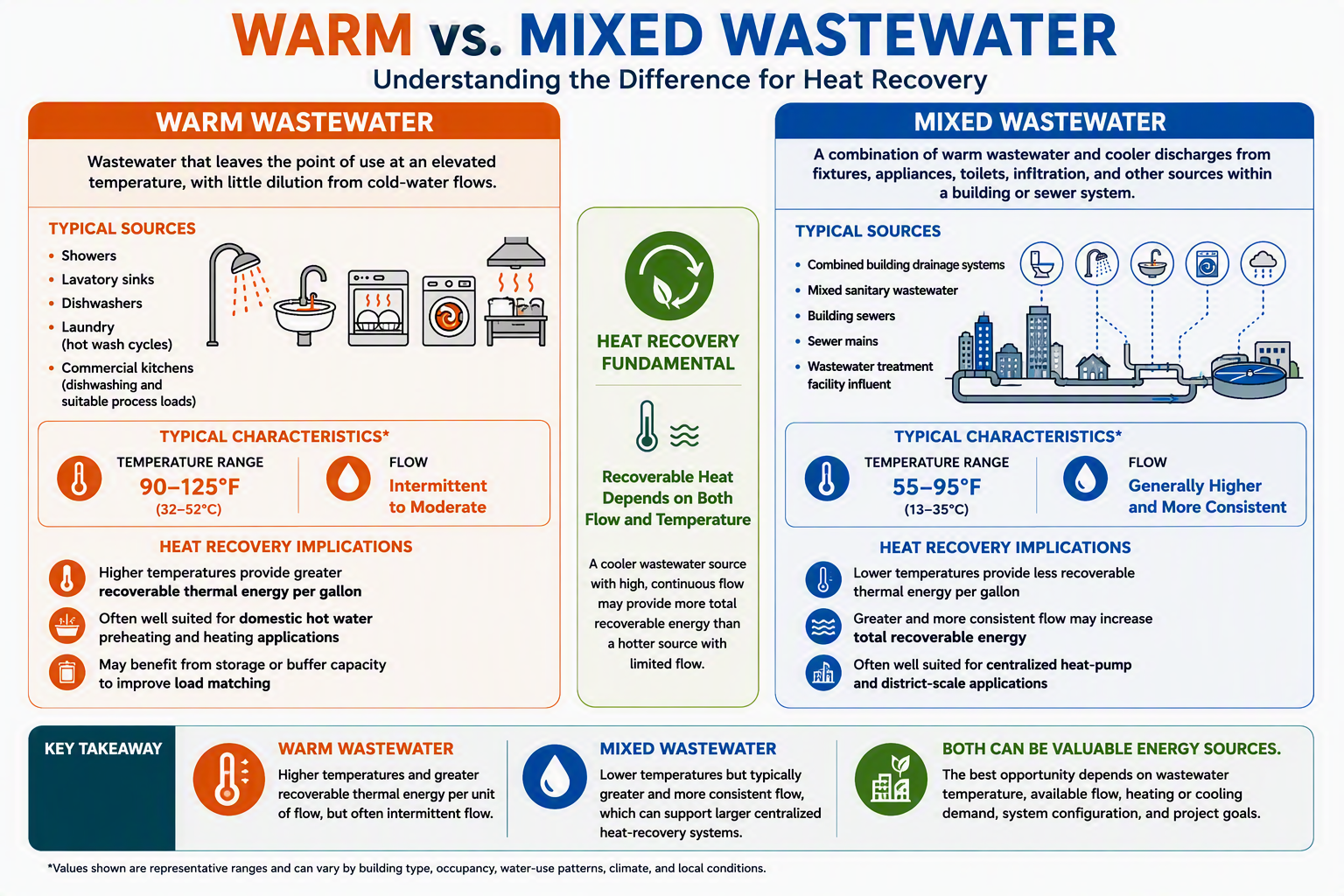
Figure 1. Warm wastewater streams typically offer higher temperatures and more recoverable thermal energy per gallon, while mixed wastewater streams often provide greater and more consistent flow for centralized heat-recovery applications. Actual heat-recovery potential depends on both wastewater temperature and available flow.
How the Systems Work
A simple way to understand wastewater heat recovery is to follow the energy path. A heat exchanger transfers thermal energy from wastewater to a separate potable-water, source-water, or hydronic loop. When the building needs a higher delivery temperature than this heat exchange can produce, a heat pump raises the low-temperature heat so it can be used for domestic hot water or space heating. In cooling applications, the process works in reverse: heat is removed from the building and transferred to wastewater, which acts as a heat sink. The exact configuration depends on the building, flow profile, wastewater quality, temperature requirements, utility costs, and project goals.
Depending on the wastewater source and equipment design, the system may also include screening, grease or solids separation, a holding tank, or a wastewater-side heat exchanger designed to handle direct exposure to wastewater. These components help protect pumps and heat-transfer surfaces and make cleaning easier. The right approach depends on solids and grease content, corrosion potential, allowable pressure drop, fouling risk, and maintenance strategy. It also depends on whether the system is recovering heat from greywater, mixed sanitary wastewater, a building drain line, or a sewer main.
Why Temperature Stability Matters
One of the biggest advantages of wastewater heat recovery is that the heat source is often more stable than outdoor air, which can fluctuate widely by season, day, and even hour. Wastewater can provide a steadier heat-pump source than outdoor air, especially where flow is collected from a large building, sewer, or wastewater-treatment facility. That said, temperature and flow still change with occupancy, time of day, water-use patterns, process schedules, infiltration, rainfall, and season. Fixture-level and small-building streams may be intermittent, while larger sewer and treated-effluent streams are generally more stable. For a heat pump, that steadier source temperature can help maintain more consistent heat-pump performance and simplify system modeling.
The best applications pair an adequate wastewater source with a substantial, recurring thermal load. Domestic hot water can be especially attractive because demand may occur year-round. When heating and cooling loads happen at the same time, a heat-recovery heat pump may transfer heat removed from the cooling loop directly into domestic hot water or another heating load, with wastewater serving as an additional source or sink depending on the system configuration.
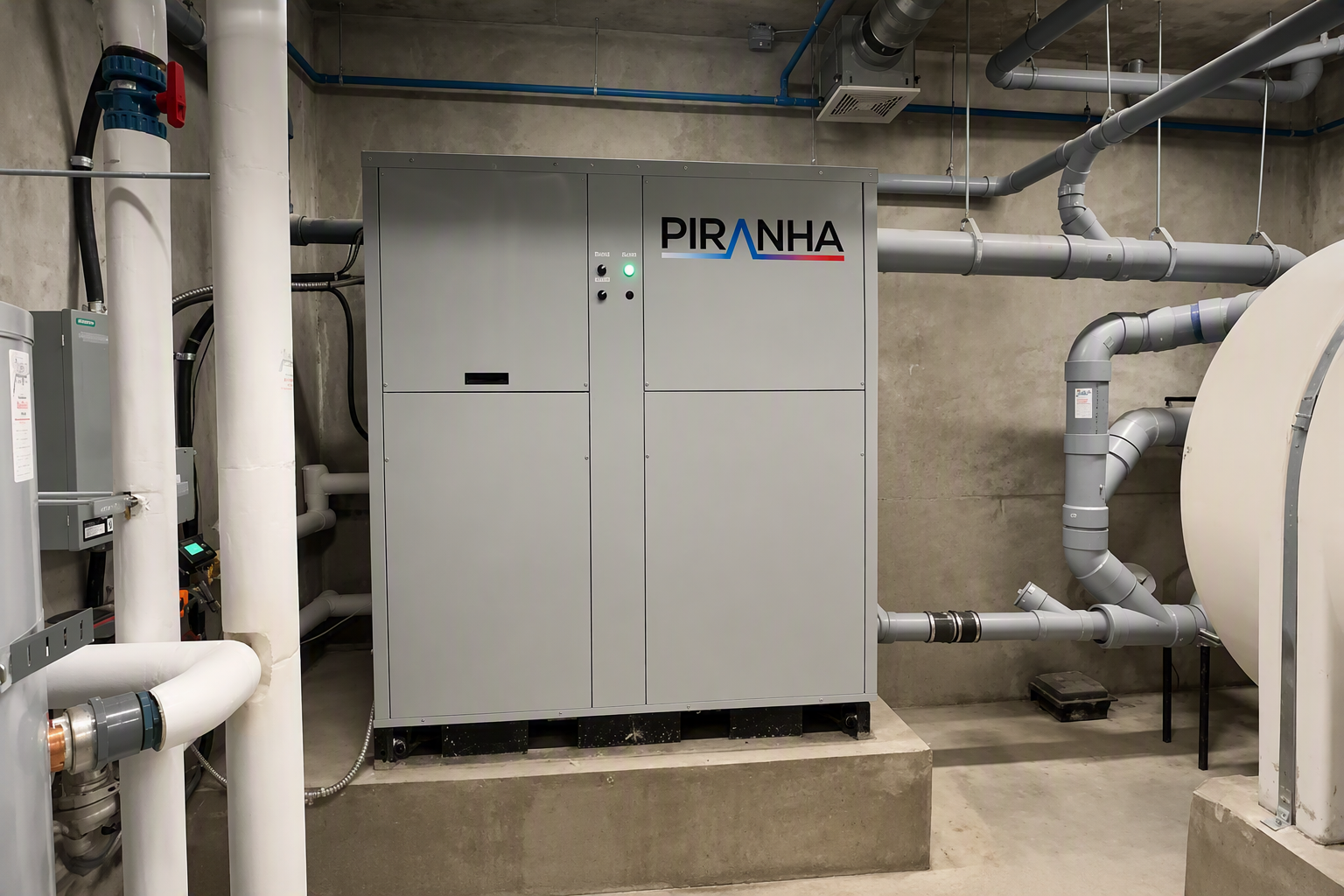
Figure 2 shows one example of a building-scale, heat-pump-assisted wastewater heat-recovery system. In the SHARC PIRANHA HC configuration shown, wastewater provides source heat, while a separate hydronic cooling loop can provide additional recovered heat during simultaneous cooling and hot-water production. A double-wall vented condenser transfers heat to potable water while the wastewater, potable-water, cooling, and refrigerant circuits remain separate.
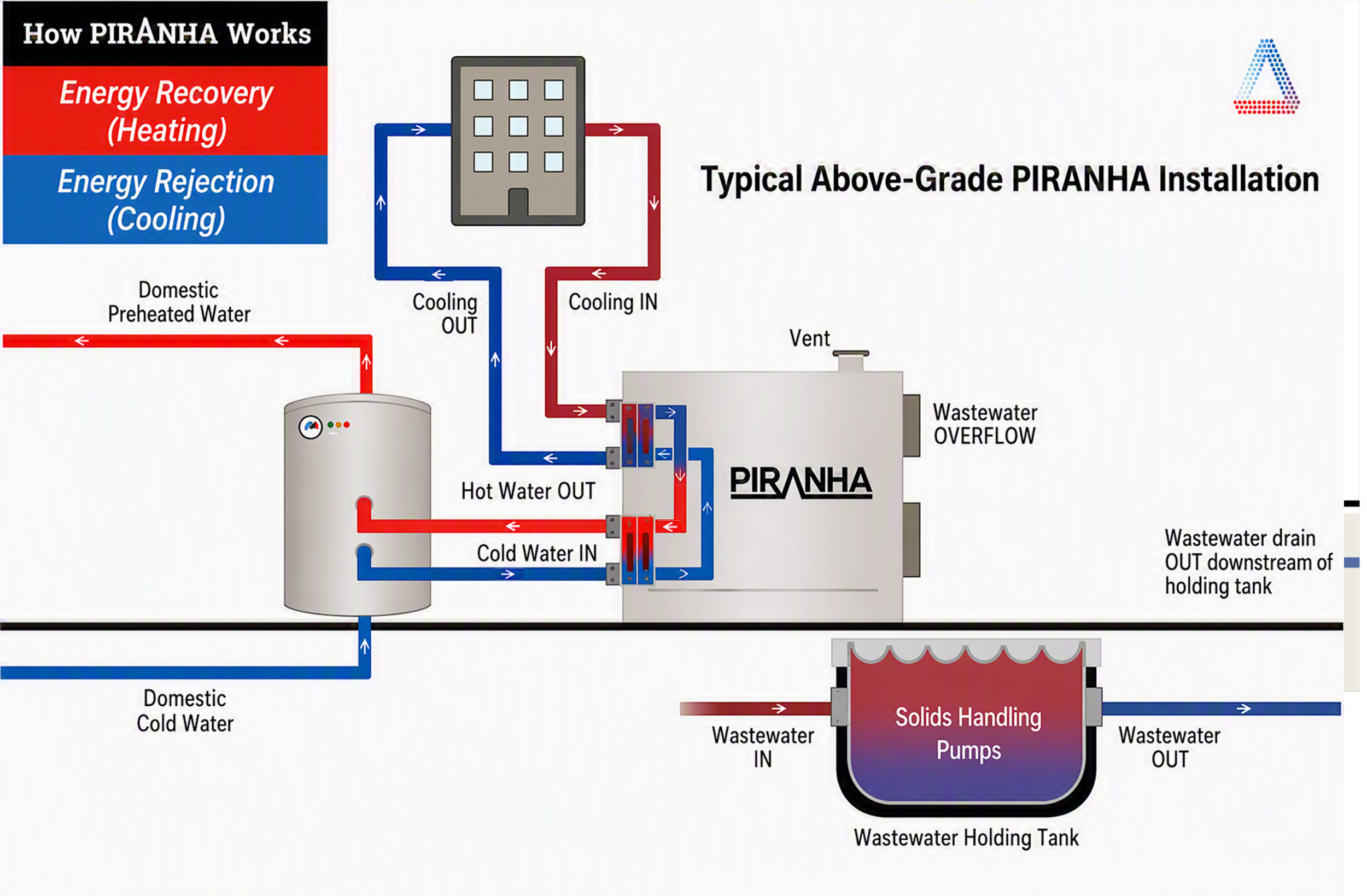
Figure 2. SHARC’s PIRANHA system uses heat pump technology to recover thermal energy from wastewater or greywater and repurpose it for domestic hot water, hydronic heating, or cooling heat rejection. Image courtesy of SHARC Energy.
Why Interest Is Growing
Wastewater heat recovery is gaining attention as building owners, utilities, and district-energy continue their search for dependable sources of low-temperature energy. The technology is already recognized in government energy-efficiency guidance, engineering research, product-testing programs, and utility resource-recovery studies. These sources consistently describe wastewater heat as a usable but underutilized resource.
Wastewater is especially attractive because it is often generated within the same facilities that require domestic hot water or space heating. In applications with sufficient flow and thermal demand, it can provide a dependable source of recoverable energy that complements modern heat-pump systems.
While not every building is a good candidate, wastewater heat recovery is increasingly being evaluated in multifamily housing, hotels, hospitals, recreation facilities, campuses, and municipal infrastructure projects where the characteristics of both the heat source and the heating load align.
What Comes Next
In the rest of this series, we’ll move from market relevance to practical application. We’ll look at the mechanical design considerations behind wastewater recovery systems, where they are most effective, and what design criteria should be met before a project moves forward. We’ll also look at U.S. and North American applications and explore potential funding options.