Optimization of Data Center Cooling and Water Efficiency Part 6: Liquid Immersion Cooling
/
Air can transport heat, but liquid transfers it with far greater density, stability, and control. That difference is why immersion cooling changes the thermal equation for data centers. Dielectric immersion fluids can provide thermal conductivity several times higher than air, while also providing much greater heat transport capacity through direct liquid contact. Instead of waiting for server heat to migrate into the room and then relying on air to remove it, immersion cooling captures heat closer to the source.
This blog looks at how immersion cooling works, why it matters for high-density AI and HPC data centers, and how it can fit into a broader strategy for reducing energy use, water demand, and cooling-system strain.
Air is not as effective as liquid at moving heat, so as heat density rises, facilities need more airflow, fan power, containment, and mechanical cooling support. In addition, they often require more space, power, and, in many cases, more cooling-water resources—all the things that make communities reluctant to welcome large data centers into their midst.
Liquid immersion cooling is one important option for high-density AI/HPC loads where air cooling becomes inefficient or impractical.
How Immersion Cooling Works
In traditional data centers, fans pull cool air across servers and carry heat away from the equipment. In immersion cooling, the server is submerged in a bath of dielectric fluid formulated for electronic equipment. The fluid absorbs heat directly from the electronics and transfers it to a cold-water loop via an external heat exchanger, which then carries the heat to another heat exchanger, process load, or heat-rejection device.
Immersion cooling is one of the most efficient ways to cool high-density servers because the dielectric fluid captures heat directly from the electronics and allows it to be removed from the data center through a liquid loop instead of room air. Immersion cooling may also integrate with existing facility-water or chilled-water infrastructure if temperature, capacity, water quality, materials compatibility, and redundancy requirements are met.
Immersion Cooling Scales Better
As data centers add server capacity, they also add heat. With air cooling, that expansion often requires:
• more server fan power
• more room airflow
• more containment complexity
• more CRAC/CRAH capacity
• more space for air movement
Not only do these upgrades place more burden on the electrical grid, but they also create another problem that makes data centers unpopular: noise. By reducing dependence on high-volume airflow and server fan power, immersion cooling can help address both thermal efficiency and noise concerns as rack densities increase.
The water-efficiency benefit comes from how immersion cooling changes the temperature profile of the cooling system. Because heat is captured directly into a liquid loop, the system may be able to reject heat at higher water temperatures than conventional chilled-air cooling. That can reduce the need for evaporative cooling and make dry, hybrid, or closed-loop heat rejection more practical, lowering on-site water use depending on climate and system design.
Challenges to Consider
While the benefits of immersion cooling are certainly cause for serious consideration, there are reasons why a data center might choose to avoid or delay investing in liquid cooling. Broadly speaking, the technology is still new and lacks standardization across systems. While standards continue to mature through efforts led by organizations such as Open Compute Project (OCP) and ASHRAE, interoperability and operational practices are not yet as uniform as those of traditional air-cooling systems.
There are also the usual cost and reliability concerns that accompany any new technology, especially when the stakes are so high. Whether to pursue liquid cooling depends on several factors that each business or enterprise must consider: financial readiness, retrofit feasibility, operational maturity, technical reliability, procurement strategy, and compliance or insurance requirements.
OCP guidance advises that immersion deployments require fluid specifications, compatibility testing, leak detection, spill containment, safety documentation, fluid-quality monitoring, and service procedures.
Immersion cooling retrofits may be especially difficult to justify because upgrades may require routing new piping, completing structural checks, upgrading floor loading, and adding containment or drainage, among other challenges.
Introducing Immersion as Part of an End-to-End Cooling Strategy
For facility operators evaluating liquid cooling, Baltimore Aircoil Company’s (BAC) entry into the immersion market is significant because it connects server-level heat capture with established heat-rejection expertise. After obtaining a licensing agreement for DUG Cool patent rights and know-how in 2024, BAC introduced its COBALT™ immersion system.
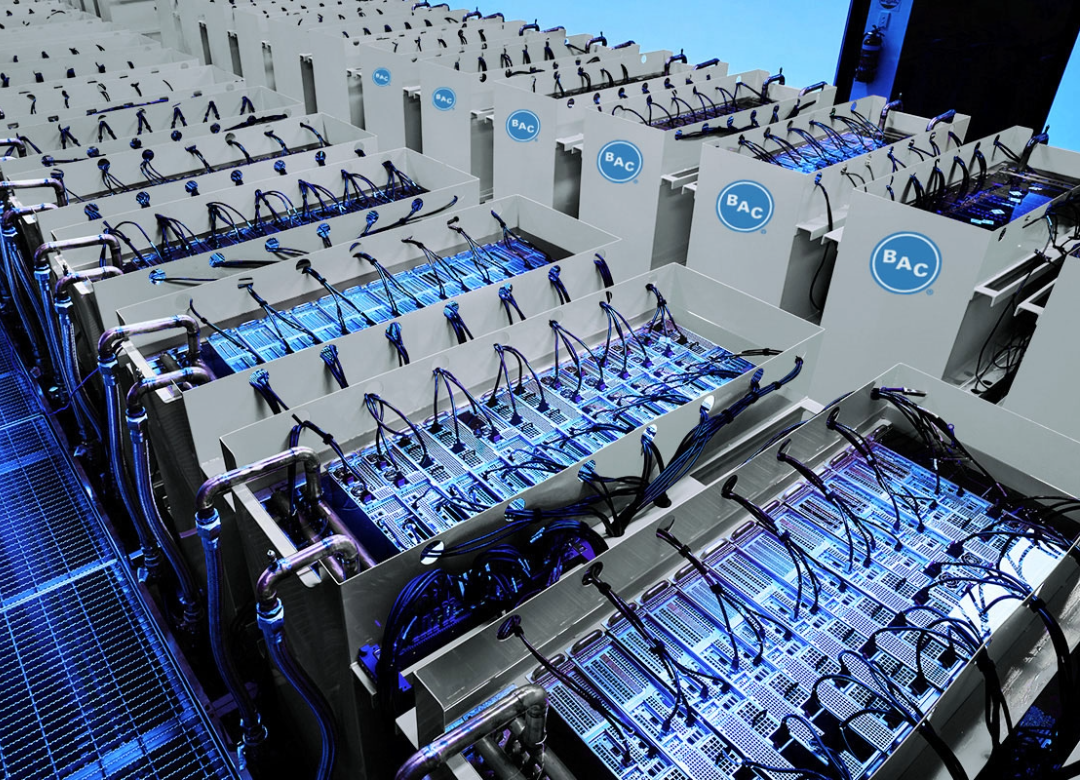
COBALT™ immersion system for direct component-to-fluid heat transfer to remove heat from servers. Image courtesy of Baltimore AirCoil.
The Cobalt system is designed slightly different from other immersion systems in that cooling-water coils are installed within the CorTex™ dielectric-fluid tank to transfer heat from the dielectric fluid to a secondary water loop. This provides more heat transfer at the heat source.
There’s one other notable perk. BAC’s COBALT™ system builds on CorTex™ tank technology as part of an end-to-end approach that pairs indoor immersion cooling with outdoor heat-rejection equipment. Systems like COBALT™ show how immersion cooling can move beyond the tank itself and become part of a broader energy- and water-optimization strategy.
Next Step in Cooling and Water Efficiency
Immersion cooling is one of the most efficient ways to cool high-density servers because it moves heat into a liquid loop before that heat becomes a room-level cooling burden. This not only reduces fan energy; it may also reduce on-site water consumption when paired with dry, hybrid, or closed-loop heat rejection. As AI and HPC loads continue to grow, immersion cooling will likely become an increasingly important part of the data center optimization conversation.