Wastewater Heat Recovery Series Part 2: Where Wastewater Heat Recovery Fits
/
In Part 1, we looked at how wastewater heat recovery works and why wastewater is a valuable thermal energy source. Here, we tackle a more practical question: Could wastewater heat recovery work here?
The answer depends less on building type than on a few project basics. Some applications are clear candidates; others lack the source conditions or thermal loads needed to succeed.
Start by screening flow, temperature, load, and operating schedules, which we discuss here. Then check wastewater quality, equipment access, auxiliary energy, approvals, and lifecycle economics.
Four Characteristics That Matter Most
Whether you’re evaluating a multifamily building, university campus, hospital, industrial facility, or district energy network, successful projects tend to share four characteristics.
1. Consistent wastewater flow. Wastewater heat recovery captures thermal energy from water already moving through a building or sewer. More flow and a larger usable temperature difference generally mean more recoverable heat, while predictable profiles simplify sizing and use.
Sources may include:
• Domestic wastewater from showers, sinks, and laundry
• Commercial kitchens and food preparation
• Hospitality facilities
• Industrial process wastewater
• Municipal sewer infrastructure
• Wastewater treatment plant effluent
Intermittent flows can still work, but systems generally perform best when substantial volumes are available throughout the day.
2. Recoverable temperature. Wastewater is often warmer than incoming cold water and winter air. In cooling applications, it can also serve as a heat sink. Even after moving through piping, it may remain warm enough for heat pumps and heat exchangers to recover useful energy.
Municipal sewer temperatures often fall in the 50s to 60s°F, depending on climate and system conditions. Wastewater leaving hot-water-intensive buildings is often in the upper 60s to low 70s°F.
Some process streams are much hotter before on-site cooling or treatment. Always verify actual temperature, chemistry, variability, and discharge limits.
3. A nearby compatible heating or cooling load. A strong wastewater source is only half the equation. The recovered energy needs somewhere useful to go.
Typical loads include:
• Domestic hot water
• Hydronic heating systems
• Snow melt systems
• Comfort heating
• Comfort cooling
• District energy networks
• Industrial process heating
In cooling mode, wastewater absorbs rejected building heat instead of supplying recovered heat.
4. Overlapping source and load schedules. Timing matters. The best opportunities occur when wastewater generation and thermal demand occur simultaneously or can be connected through storage. Dormitories, hotels, hospitals, and multifamily buildings often show this overlap, but seasonal and hourly profiles still need to be checked.
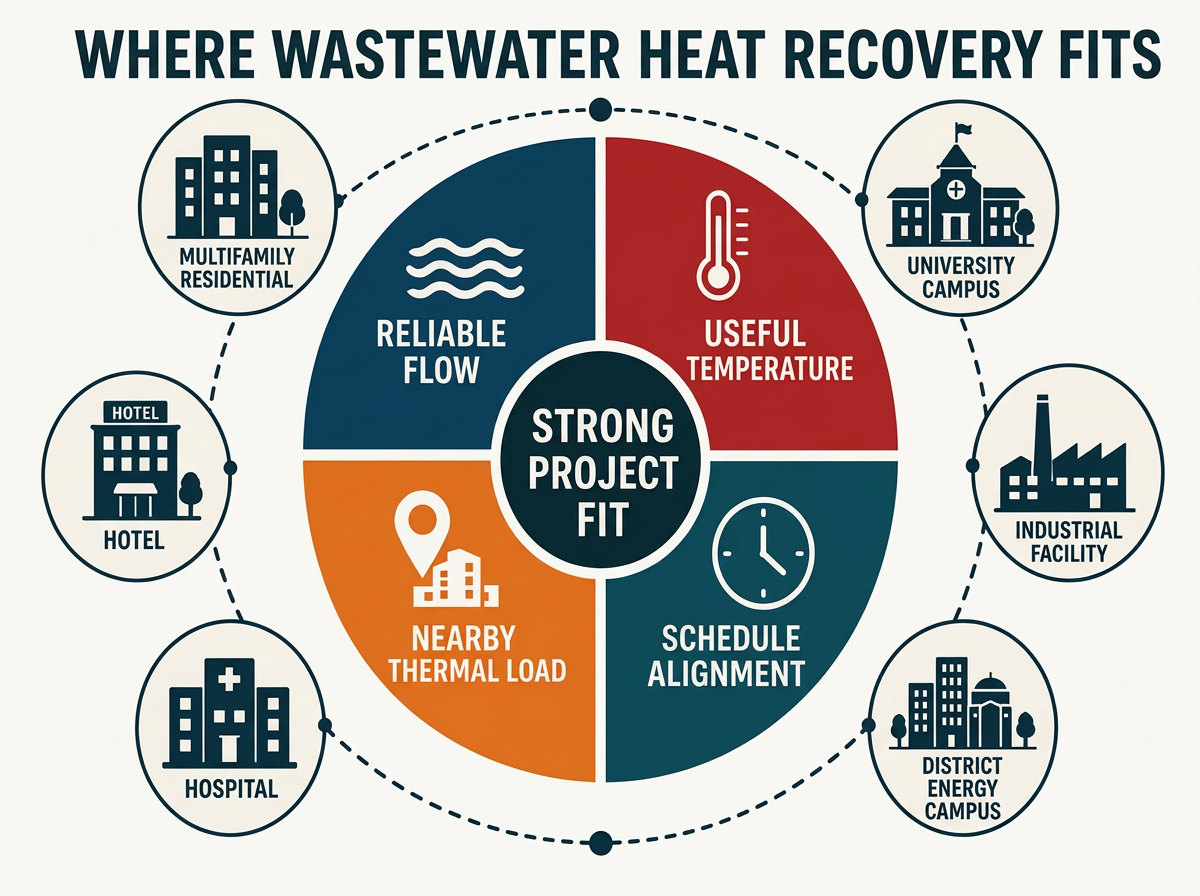
Figure 1. Strong wastewater heat recovery candidates pair the right facility type with four key conditions: reliable flow, useful temperature, a nearby thermal load, and aligned operating schedules.
Facilities That Make the Best Candidates
These facility types are often the strongest candidates for wastewater heat recovery.
Multifamily residential buildings. These are usually among the first applications considered for because they typically offer high domestic hot water demand, daily occupancy, predictable wastewater generation, and relatively short distances between source and load
Hotels and hospitality facilities. Hotels generate substantial wastewater from showers, laundry, and kitchens while maintaining steady domestic hot water demand. That source-and-load pairing makes them especially attractive.
Student housing and university campuses. Residence halls combine large domestic hot water loads with significant wastewater generation. Campus layouts also add the option of shared infrastructure through central plants or district systems.
Hospitals and healthcare facilities. Healthcare facilities often have some of the steadiest year-round hot water demand. Stable occupancy and operations can create favorable conditions for wastewater energy recovery.
Industrial facilities. Some operations discharge warm process wastewater while running compatible loads. Recovering that energy can be especially valuable at scale, though each site needs an individual assessment.

Campus and district energy. Some of the strongest projects extend beyond one building. Connecting multiple sources and loads across a campus adds flexibility and can improve system use.
Why Domestic Hot Water Is Often the First Load Target
Domestic hot water is often the first target for recovered wastewater heat because:
• The demand frequently exists year-round.
• Water heating is a major energy consumer in many facilities.
• Supply temperature requirements are well understood.
• Thermal storage can often be integrated into the system.
That makes domestic hot water a practical entry point, especially in multifamily, hospitality, student housing, and healthcare facilities.
Where Source Meets Load
The best wastewater heat recovery projects bring source and load together: reliable wastewater flow, recoverable temperatures, nearby thermal demand, and overlapping schedules. Whether the site is a multifamily tower, hospital, hotel, campus, industrial facility, or district network, the same screening principles apply.