Optimization of Data Center Cooling and Water Efficiency Part 5: From Heat Rejection to Heat Recovery
/
For decades, data center cooling has been designed around one core assumption: heat is a problem to remove. Servers generate it, cooling systems collect it, and mechanical equipment rejects it to the atmosphere. That approach is essential for protecting uptime, but it also treats one of the facility’s largest energy streams as waste.
That assumption is changing.
As rack densities climb and liquid cooling becomes more common, the heat leaving the IT environment is becoming more concentrated, more controllable, and more useful. In other words, the conversation is shifting from heat rejection to heat recovery.
Why Warmer Cooling Water Changes the Equation
Traditional air-cooled data centers reject heat into an exhaust stream that is only modestly above room temperature, making it difficult to reuse effectively.
Warm-water liquid cooling changes that. Direct-to-chip cooling, rear-door heat exchangers, and other liquid-based cooling strategies capture higher temperature heat closer to the source. Newer AI-focused deployments are pushing rack densities beyond previous conventional chilled-water assumptions. Many warm-water liquid cooling designs operate in ASHRAE/OCP liquid-cooling classes around 104°F-113°F (40–45°C), with some specialized systems operating above that range. Higher return-water or waste-heat temperatures can improve heat recovery potential, especially when paired with heat pumps or district energy systems..
That higher temperature matters because higher-grade heat is more practical and economical to recover. A warm, stable hydronic source can be used directly in some applications or serve as a favorable source for a heat pump or heat recovery chiller. Put simply: the warmer and more consistent the source, the more practical heat recovery becomes.
Whether recovered heat can be used directly depends on both the available source temperature and the temperature required by the destination load.
Following the Energy Instead of Fighting It
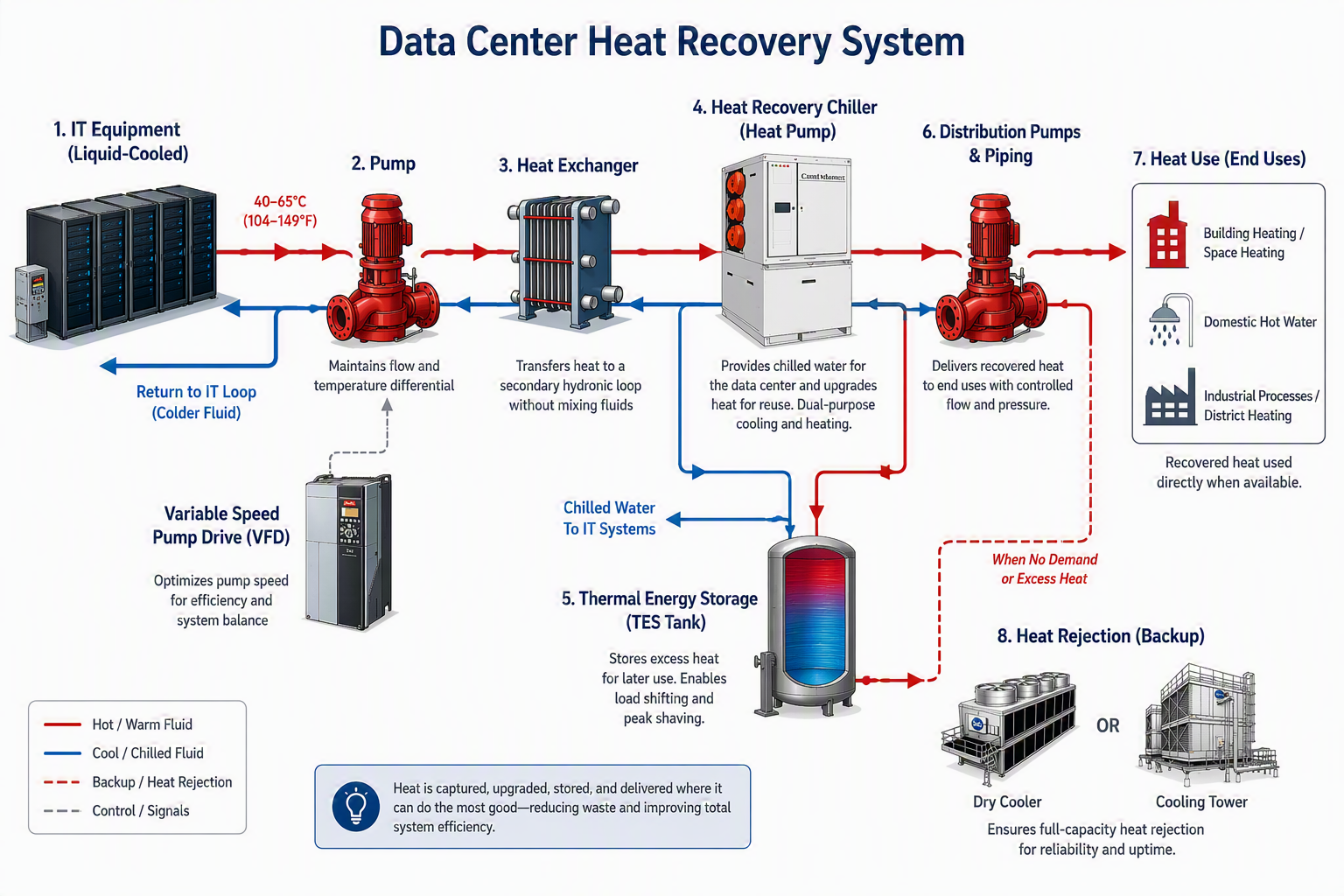
To understand heat recovery, it helps to stop thinking only in terms of cooling loops and start thinking in terms of energy movement. Heat begins at the rack level, where high-density servers generate significant thermal loads. Liquid cooling allows that heat to be captured efficiently and moved through a hydronic system.
From there, pumps move heated fluid out of the IT loop and into the broader mechanical system. In a heat recovery design, pumping is not just about circulation. It is about maintaining the right flow rates and temperature differentials so the system can preserve useful thermal energy and deliver it where it can do work.
Once the heat leaves the IT loop, heat exchangers become the first major transition point. They allow heat to move into a secondary hydronic loop without mixing fluids, preserving system integrity while creating flexibility downstream. This is where high-efficiency plate-and-frame or high-K heat exchangers become central to the design. Their performance directly influences how much energy can be captured, transferred, and put to use.
Where Recovered Heat Can Go
Recovering heat is only half the challenge. The system also needs a useful place to send it.
If the recovered temperature is high enough and a load is available, heat can be used directly for domestic hot water, building heating, reheat, snow or ice melt, or nearby process loads.
On-site uses can be valuable, but a data center’s own heating loads may be small compared with the amount of heat it rejects. A larger opportunity exists in campus or district applications, where recovered heat can be distributed to nearby buildings or systems with steadier thermal demand.
In a campus setting, the data center becomes more than a cooling load. It becomes a consistent thermal source that can support adjacent buildings, mixed-use developments, offices, multifamily properties, or other facilities that need heat.
The Role of Heat Recovery Chillers
In many systems, the captured heat is useful but not quite hot enough to serve the intended load directly. That is where heat recovery chillers come in.
A heat recovery chiller can provide chilled water for the data center while raising recovered heat to a useful temperature for building, campus, or district loads. This lets the system serve cooling and heating needs together instead of treating them as separate problems.
That dual-purpose function is what makes heat recovery chillers so important in modern data center design. They create a bridge between the need to remove heat from IT equipment and the opportunity to use that heat somewhere else.
They also give operators flexibility. Depending on demand, the system can adjust the balance between cooling output and heating output, allowing the mechanical plant to respond to changing building or district conditions.
Solving the Timing Problem with Thermal Storage
Even when heat is recoverable and a use exists, timing can still get in the way. Data centers generate heat continuously, but heating demand varies by time of day and season.
Thermal energy storage can help solve that mismatch. By storing excess heat during periods of low demand and releasing it later, storage allows recovered energy to be shifted across time instead of being rejected when it cannot be used immediately.
In practice, this may involve water-based storage tanks, while more advanced systems may use phase-change materials to increase storage density.
For heat recovery systems, storage is not just an add-on. It can be the difference between occasional heat reuse and a system that operates consistently across changing demand conditions.
Moving Heat Where It Needs to Go
Once heat is captured, transferred, and conditioned, it still has to be delivered. Water-side heat recovery systems are well suited to this because they allow energy to be transported with control through hydronic piping networks.
But distribution matters. Thermal losses in piping, infrastructure cost, and proximity between the data center and the heat user all affect whether a project is practical.
That is why heat recovery is often most compelling in campus environments, district energy networks, and developments where the heat source and heat users are close enough to be connected economically. The economic viability of heat recovery often depends less on the amount of available heat and more on the consistency of nearby heating demand.
The design question is not simply, “Can we recover heat?” It is, “Can we match the right temperature, flow, distance, and demand profile so the recovered heat can be used effectively?”
The Supporting Components That Make Recovery Work
Heat recovery is often discussed in terms of major equipment — heat exchangers, heat recovery chillers, and thermal storage. But the supporting components are just as important to successful operation.
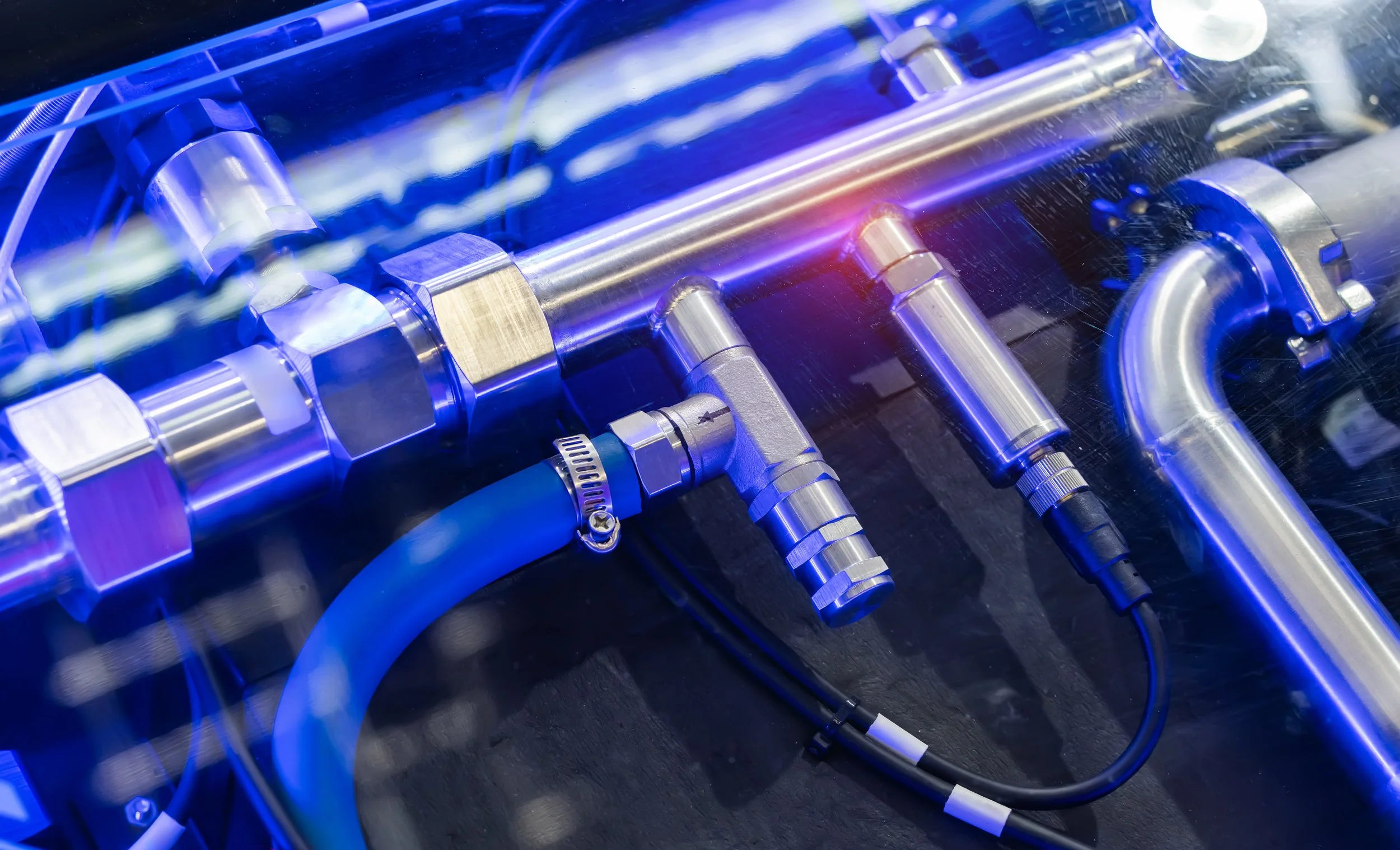
Pumps maintain flow and support system flexibility across operating modes. Heat exchangers determine how efficiently energy moves between loops. Thermal storage stabilizes operation when supply and demand do not line up perfectly. Flexible hose assemblies help connect equipment, absorb thermal expansion, reduce vibration, and support modular or skid-mounted layouts.
These details matter because modern data center mechanical systems are becoming more dynamic. Space is limited, equipment is increasingly modular, and systems may need to operate across multiple thermal modes depending on IT load, weather, and heat demand.
Heat Recovery Does Not Eliminate Heat Rejection
Heat recovery changes the priority of the system, but it does not eliminate the need for heat rejection. Data centers still require adequate backup or supplemental heat rejection capacity — such as dry coolers, cooling towers, or hybrid systems — to protect reliable operation under all conditions.
Uptime remains the first priority.
What changes is the operating strategy. Instead of rejecting heat by default, the system prioritizes reuse whenever conditions allow. Only excess heat — when there is no demand or when operating conditions require it — is rejected.
That shift reframes the mechanical plant. The cooling system is no longer just a utility that removes heat. It becomes part of a broader energy strategy that can reduce waste and improve total system efficiency.
A Broader Definition of Data Center Efficiency
A data center can be efficient not only by reducing the energy required to cool IT equipment, but also by putting the heat it already produces to useful work. That may mean supporting nearby buildings, integrating with a district energy network, or offsetting other heating loads.
As server densities increase and liquid cooling becomes more prevalent, both the quantity and quality of recoverable heat are expected to grow. At the same time, advances in heat exchangers, heat recovery chillers, and thermal storage are making recovery systems easier to integrate into real projects.
Ultimately, the most efficient data center is not just one that removes heat effectively. It is one that puts that heat to work.