Optimization of Data Center Cooling and Water Efficiency Part 4: Sourcing Water You Don’t Have to Buy
/
We’ve talked about ways to reduce data center water consumption through non-evaporative and hybrid heat rejection. Even so, it is unlikely that data centers will abandon evaporative cooling altogether. It is too effective—and often too economical—to disappear from the toolbox. But one trend is clearly shaping the future of data center design: stop using drinking water for jobs that do not require it.
That matters because one of the largest non-potable loads in many water-cooled data centers is cooling tower makeup water.
Several on-site sources can offset that draw:
Rainwater harvesting. Large data centers can have roof areas well above 100,000 square feet, making them strong candidates for rainwater harvesting. Data center roofs are typically flat, highly impermeable membranes or metal surfaces, with runoff coefficients in the 0.8–0.9 range. In plain language, that means 80–90% of the rain that falls on the roof can become usable runoff, before storage and treatment losses.
The general rule of thumb is 1 inch of rain on 1 square foot of roof yields about 0.62 gallons of water. That equals roughly 620 gallons per inch of rain for every 1,000 square feet of catchment area. A 250,000-square-foot roof in the southeastern U.S. could conservatively yield several million gallons of usable water per year (see Figure 1). Please note than annual harvestable volume depends on the specific catchment area, local rainfall, roof/surface runoff, first-flush diversion, and storage sizing. Screening estimates should be validated with these project-specific values.
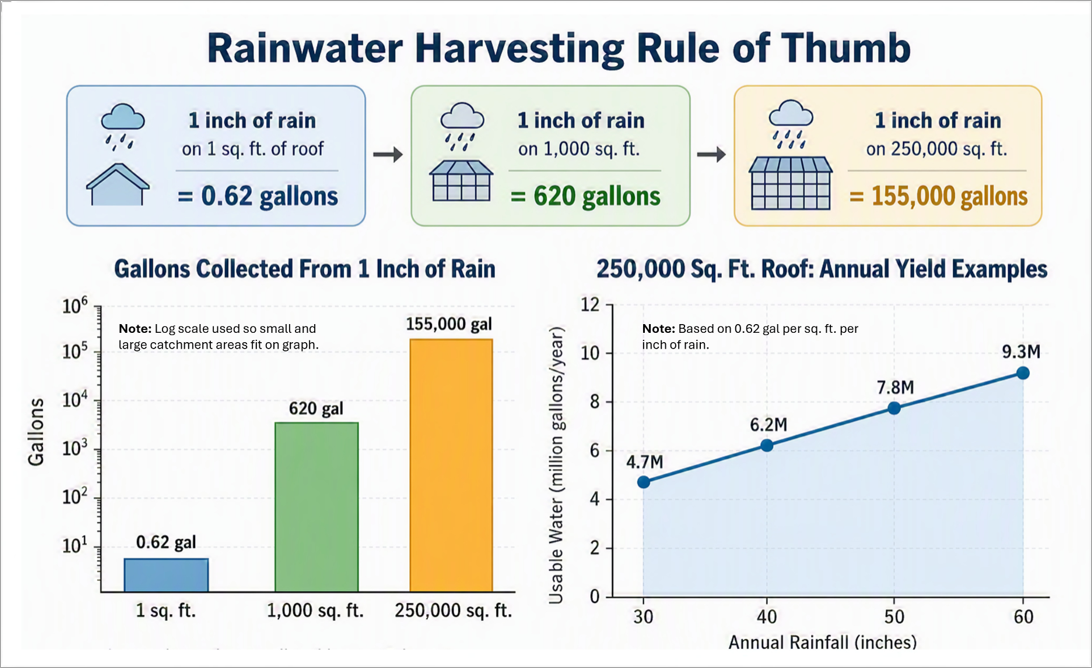
Figure 1: Estimated annual rainwater harvest for various roof sizes in the Southeastern U.S., shown in millions of gallons, based on annual rainfall scenarios of 45, 55, and 65 inches and an assumed net capture efficiency of approximately 85%. Actual harvestable volume depends on the specific catchment area, local rainfall, roof/surface runoff, first-flush diversion, and storage sizing.
Stormwater harvesting. At- or below-grade capture from site drainage can yield even larger volumes than rooftop collection but usually requires more treatment for cooling tower use. In the Southeast, a single acre of impervious surface may receive about 1.2–1.6 million gallons of rainfall per year. Large data center campuses may occupy 40 acres or more. That means the theoretical stormwater volume can reach tens of millions of gallons annually (see Figure 2). The harvestable amount depends on site grading, storage volume, first-flush diversion, treatment requirements, and local stormwater regulations.
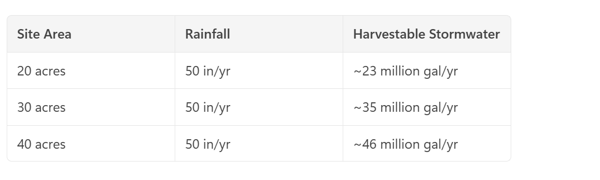
figure 2. Theoretical estimate of harvestable stormwater given site area and annual rainfall.
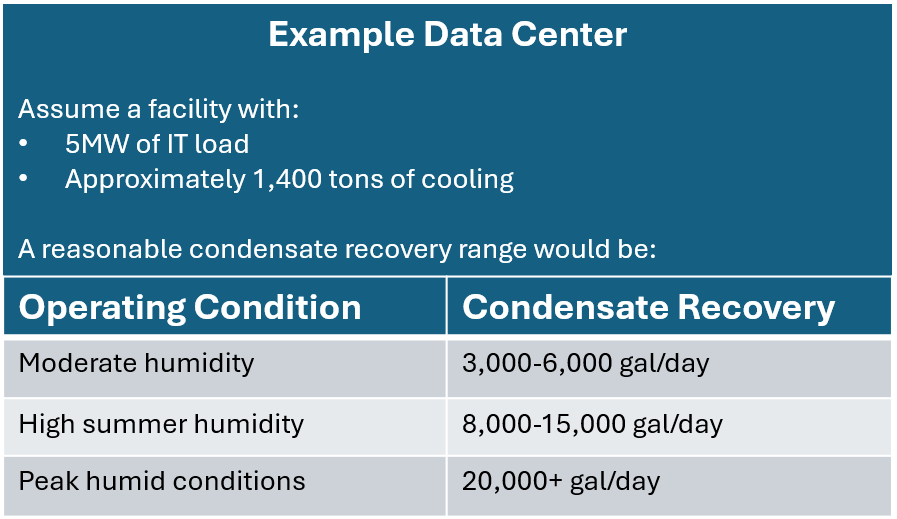
Figure 3. Rough estimate of CRAH/AHU condensate recovery possible in data center in southeastern US. Dependencies include outdoor air load, humidity, coil conditions, and operating hours.
Condensate recovery. In humid climates, condensate from CRAH units and air-handling units can be a valuable source of high-quality water. Condensate is often attractive because of low mineral content and peak coincidence with cooling loads, but final suitability still depends on the cooling-tower treatment program and water-management controls.
Large facilities in cities such as Atlanta, Charlotte, Nashville, and Raleigh can generate significant condensate during much of the cooling season (see Figure 3). However, actual volume depends on outdoor air load, humidity, coil conditions, and operating hours.
Cooling tower blowdown recovery. Cooling tower blowdown can also be captured, treated, and reused. It may be returned to the condenser water system or used for other appropriate non-potable purposes. Blowdown is the concentrated water intentionally discharged to control dissolved solids, scaling, and biological growth in cooling towers. Blowdown recovery usually requires a treatment train (for example filtration, demineralization, and/or reverse osmosis), creates a concentrated waste stream, and should be evaluated against local water/sewer rates and plant load.
Gray water reuse. Gray water is typically the least abundant recovery source in data centers. There simply aren’t enough people working in data centers to generate much wastewater. Gray water reuse makes more sense in water-intensive occupied facilities like hospitals, hotels, or campuses with showers, kitchens, or laundries.
All of these can legally and practically feed cooling tower makeup, toilet and urinal flushing, and/or irrigation — but only if the system is designed to the applicable codes and standards.
What the Codes Require
Non-potable reuse is well established in code, but it is also exacting. Get the plumbing wrong, and that water-saving idea can quickly become plan-review problem a. Plumbing engineers should be familiar with:
IPC Chapter 13, Non-potable Water Systems. In International Plumbing Code jurisdictions, this chapter provides the base framework for the collection, storage, treatment, and distribution of non-potable water.
CSA B805/ICC 805 and ARCSA/ASPE standards. CSA B805/ICC 805 provides a comprehensive framework for rainwater harvesting systems. It is also recognized as an alternative path for regulating certain rainwater systems. ARCSA/ASPE/ANSI 63 (Rainwater Catchment Systems) addresses rooftop rainwater catchment. ARCSA/ASPE/ANSI 78 (Stormwater Harvesting Systems Design for Direct End-Use Applications) addresses stormwater harvesting for direct end-use applications. Uniform Plumbing Code jurisdictions address similar topics through alternate-water-source provisions.
Permitted end uses. Codes and standards commonly recognize non-potable applications such as cooling tower makeup, toilet and urinal flushing, irrigation, and certain industrial or process-water uses, subject to local approval and water-quality requirements.
Where designs get tripped up:
Cross-connection control and backflow prevention. Potable and non-potable systems must be positively separated, and any potable makeup into a non-potable system requires proper backflow protection. This is one of the most important plan-review issues to get right.
Identification. Non-potable distribution piping must be clearly marked, color-coded, and labeled so it cannot be mistaken for potable water. The familiar purple-pipe convention is one common example.
Materials and treatment. Components must be suitable for the water source, treatment process, pressure, temperature, and end use. Filtration and disinfection requirements should be selected based on the intended application and the authority having jurisdiction.
Water quality for tower makeup. Harvested water does not get a free pass on cooling tower chemistry. The system still has to manage suspended solids, scaling, corrosion, and biological growth. In some cases, an alternative source raises the stakes on treatment and monitoring. That is because incoming water quality can vary more than municipal makeup.
Making Every Gallon Count
Data centers will continue to need reliable cooling, but that does not mean they have to rely only on potable water. By capturing and reusing water already available on-site, facilities can reduce demand on municipal supplies, improve resilience, and make evaporative cooling a more responsible part of the overall strategy.