Optimization of Data Center Cooling and Water Efficiency Part 3: Closed Loop Heat Rejection
/While many existing data centers use open cooling towers for heat rejection, most newly built centers are opting for less water-intensive strategies. Closed-loop systems (including heat rejection) are becoming increasingly common, especially in areas with water scarcity or sustainability mandates. The Data Centre Alliance’s 2025 Water Usage Guide similarly urges shifting toward liquid/hybrid cooling and dry economizer systems to reduce direct water draw.
In this post, we discuss some of the most viable solutions and how they fit into modern data center design.
Matching Heat Rejection to the Cooling Architecture
Closed-loop heat rejection methods can save millions of gallons of water annually, minimize maintenance and chemical treatment, and extend equipment life by isolating process fluids from the outside environment. Selecting the optimal heat-rejection device requires matching its design and performance characteristics to the data center’s overall cooling architecture, IT load profile, local climate, and other site-specific factors.
The decision typically begins upstream, in the server room itself. Will the space be air-cooled by an under-floor distribution system? Will there be rear door heat exchangers affixed to the server racks? Will a closed-loop be required between cold plates at the server and a liquid-to-air heat exchanger to reject hot air? If you are designing a modern data center with an AI workload, you may even be designing an architecture that begins with direct-to-chip liquid cooling.
In any case, your terminal heat-rejection device will be preceded by an air- or water-cooled chiller or a dedicated air conditioning or air handling unit. The temperature of the water or process fluid, along with the capacity you need, will determine which heat rejection device is best suited for your application.
Closed Heat Rejection Devices
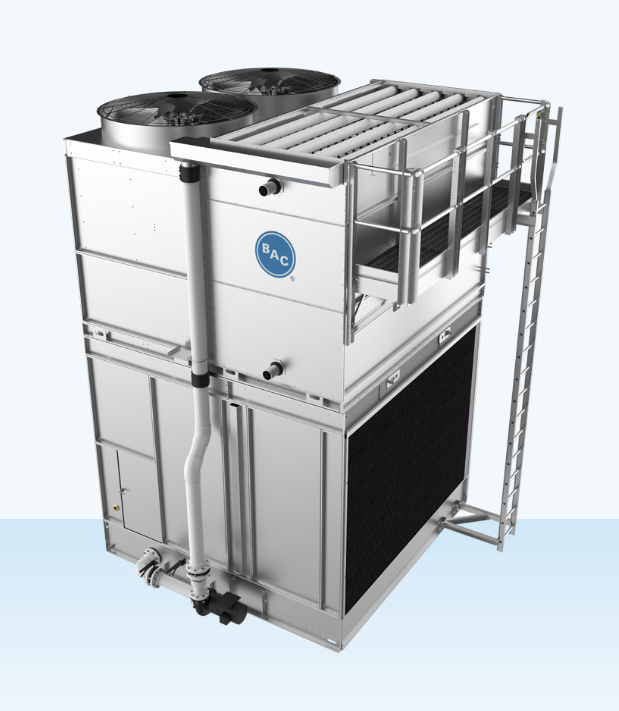
Closed-circuit Cooling Tower
Closed-Circuit Cooling Towers. Closed-circuit cooling towers, also known as evaporative fluid coolers, operate similarly to open cooling towers except that the heating load is rejected to the ambient air from a process fluid (typically glycol) flowing through a coil. Non-process water is sprayed from nozzles positioned near the top of the tower.
A fan blows air across the wet surface on the outside of the coil, causing some of the water to evaporate which cools the fluid inside. The cycling of the fan(s) controls the fluid's temperature. Make-up water is required for the spray water, but not for the cooling medium inside the coil, so closed-circuit cooling towers use less water than open cooling towers.
Data center operators often favor closed-loop fluid coolers for their cleanliness and water savings. Closed-circuit towers require less water treatment and have lower risk of contamination or scaling, which is crucial in mission-critical environments like data centers. They also simplify maintenance by keeping process fluid isolated, preventing airborne debris or microbes from entering the IT cooling loop. These benefits make closed-circuit designs a “preferred choice” for data centers that need reliable, precise cooling without water quality issues. An open tower can cool water to within approximately 2–3°F of the air’s wet-bulb temperature, whereas a closed tower might have a few degrees higher approach due to the coil resistance.
Closed-circuit cooling towers are only slightly less efficient than open towers. This slight difference is due to the fact that they lack direct contact evaporation of the process fluid. Closed towers still reject heat effectively, especially given their advantages.
Closed fluid coolers can replace open towers in most scenarios, although they typically have a larger footprint or slightly lower capacity per module due to the added coil heat exchanger. They are also well-suited for direct-to-chip or immersion cooling in data centers with heavy AI workloads.
Dry Coolers. Dry coolers, also called air-cooled fluid coolers, use ambient air to cool the process fluid. Large fans pull (or push) air across a fin-and-tube heat exchanger, which contains the process fluid. Dry coolers can cool the circulating fluid to within several degrees (typically 5–15°F) of ambient dry-bulb.
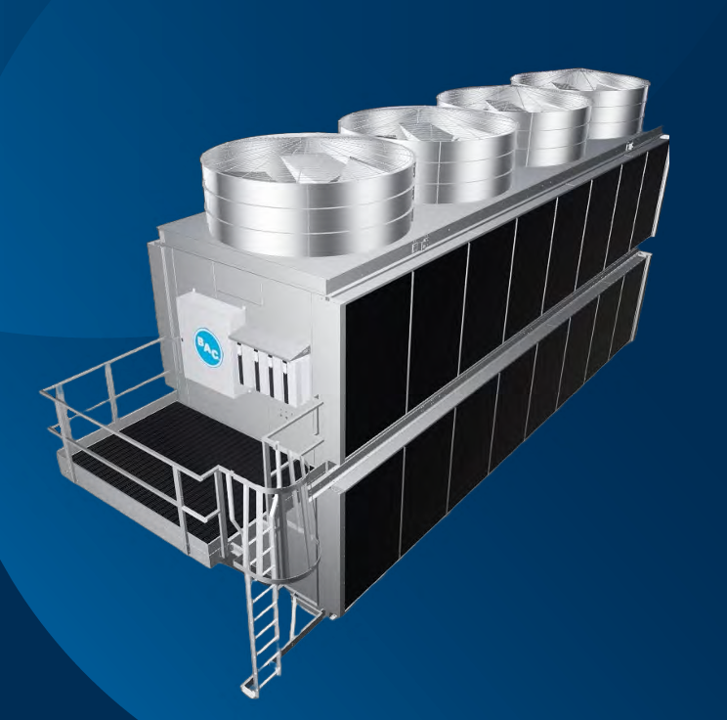
Dry Coolers
All heat rejection is sensible. There is no evaporation of water. Because the system is completely closed, there is minimal fouling or contamination risk, and maintenance is also low.
Dry coolers use more energy than closed-circuit cooling towers but excel in water efficiency with an extremely low WUE (near zero water per kWh).
They are a good choice in cool climates, where they may be able to provide most, or even all, of a data center’s internal cooling for much of the year. Data Center Knowledge notes dry cooling works best when outdoor temperatures stay below about 80°F and can significantly extend free-cooling hours in moderate climates.
Dry coolers are a common heat rejection choice for liquid-cooled servers (like immersion tanks), especially when minimizing water use is a priority.
Adiabatic Coolers. Adiabatic coolers enhance dry cooling by introducing controlled evaporation to pre cool the air before it reaches the unit’s finned coil exchanger. This approach boosts heat rejection performance during hot weather while protecting components from moisture related damage.
Two primary design approaches are used:
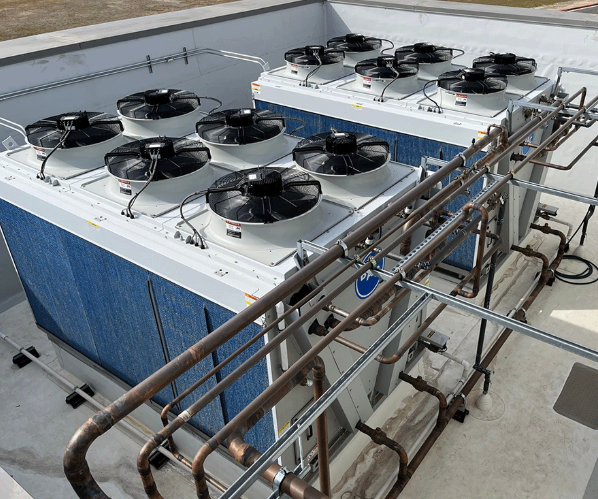
Adiabatic Coolers
• Water Spray into the Airstream - Fine droplets are sprayed directly into the incoming airstream, where they evaporate almost immediately. The evaporation cools the air before it encounters the coil, lowering process fluid temperatures while keeping coil fins dry. A properly designed system prevents any droplet carryover, protecting the coil from scale, corrosion, and fouling.
• Wetted Pad Pre Cooling – This approach uses specially engineered wetted pads positioned upstream of the coil. Water flows evenly across the pad, creating a large air water interface. The pad cools the incoming air through evaporation while physically preventing water from reaching the downstream coil. The water distribution system keeps the pad uniformly wet to maximize evaporative efficiency and minimize scale formation.
In either case, the coil remains completely dry, eliminating long term corrosion and scaling, assuming the adiabatic system is properly designed and maintained.
Adiabatic coolers can operate more efficiently at partial loads (and in milder conditions) by often running in dry mode or with reduced fan speeds, further increasing their overall energy efficiency. They also extend economizer hours and lower kWh per cooling ton in dry climates.
Hybrid Coolers. While adiabatic coolers combine the benefits of dry and evaporative cooling, hybrid coolers allow an “either-or” approach.
During cooler weather or when IT loads are reduced, hybrid coolers function like traditional dry coolers. Only air is used to cool the process fluid, resulting in zero water usage and lower maintenance needs. This mode of operation is especially valuable in regions with water scarcity or during seasons when evaporative cooling is unnecessary.
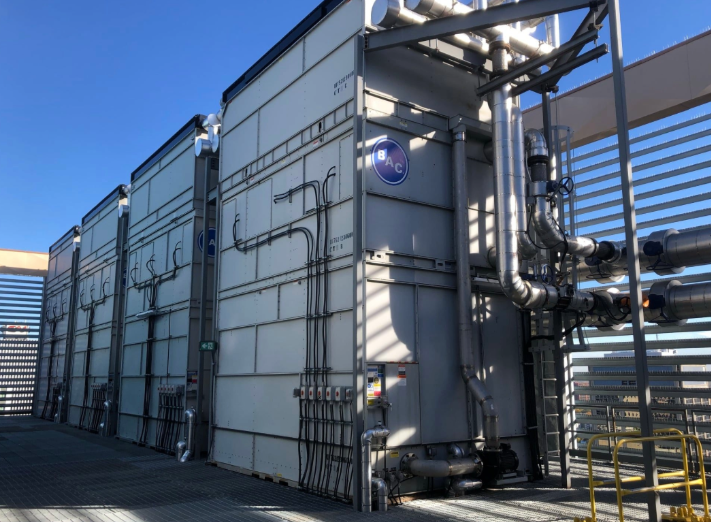
Hybrid Coolers
During hot ambient conditions or periods of peak heat load, the system introduces water in a controlled manner—either as a fine spray or as part of an adiabatic pre cooling process. The evaporation cools the incoming air before it reaches the coil, enabling the cooler to achieve lower process fluid temperatures than it can during dry operation alone. This ensures reliable performance even during design day temperatures.
Hybrid coolers provide operators with the flexibility to choose the most efficient cooling mode at any given time.
• Use dry mode to conserve water during mild conditions.
• Switch to evaporative mode on high ambient days to reduce fan energy and increase cooling capacity.
Hybrid coolers excel in climates where temperatures occasionally exceed the capacity of cooling alone. In cooling seasons, they run dry; in summer, evaporative assistance ensures reliable thermal performance. Hybrid coolers consolidate dual cooling functions into one system, which can simplify retrofits or future capacity expansions in space-constrained sites.