Optimization of Data Center Cooling and Water Efficiency Part 2: Open Loop Cooling Towers
/Heat rejection is the most consequential aspect of data center cooling design. Data centers are driven to optimize heat rejection to minimize, or even eliminate, their reliance on chillers. There is a wide range of both traditional and evolving solutions which we will explore as this series progresses. In this blog, we focus on heat-rejection via open cooling towers.
Crossflow and Counterflow
There are two types of open-loop cooling towers used in HVAC and process cooling: crossflow and counterflow. Both configurations reject 75% to 95% of heat through evaporation. The remaining heat is removed by sensible heat transfer, in which the air temperature increases as it contacts the water.
Counterflow cooling tower fans pull air from the bottom to the top of the tower, while pressurized nozzles spray warm return water from heat rejection equipment (e.g. chiller, heat exchanger, air conditioning units, etc.) downward through a fill media. As the water flows downward, it loses its heat to the upward-passing air. The cooled water collects at the bottom of the cooling tower and is recirculated back into the system.
In a crossflow cooling tower, water enters from the top and flows down through the fill media while fans draw ambient air horizontally across the wetted fill media. Crossflow cooling towers do not have spray fixtures – the water drains by gravity through nozzles, flowing vertically through the fill and into the tower basin.
Heat Paths from Servers to Cooling Towers
The path by which heat moves from IT equipment to the cooling tower depends on the data center’s cooling architecture, as shown in Figure 1. In air‑cooled systems, heat from the servers is exhausted and transferred to chilled water at the cooling coils before entering the cooling tower. In liquid‑based systems—including liquid cooling, air‑assisted liquid cooling, and direct liquid cooling—heat is captured at or near the server components by a coolant loop, then delivered to a heat exchanger, which rejects the heat to the facility’s cooling loop and ultimately to the cooling tower.
Because each method uses different heat‑transfer media and intermediate components, the overall heat path varies accordingly. The figure below shows various examples and is not meant to be fully inclusive of cooling center architecture, which varies significantly.
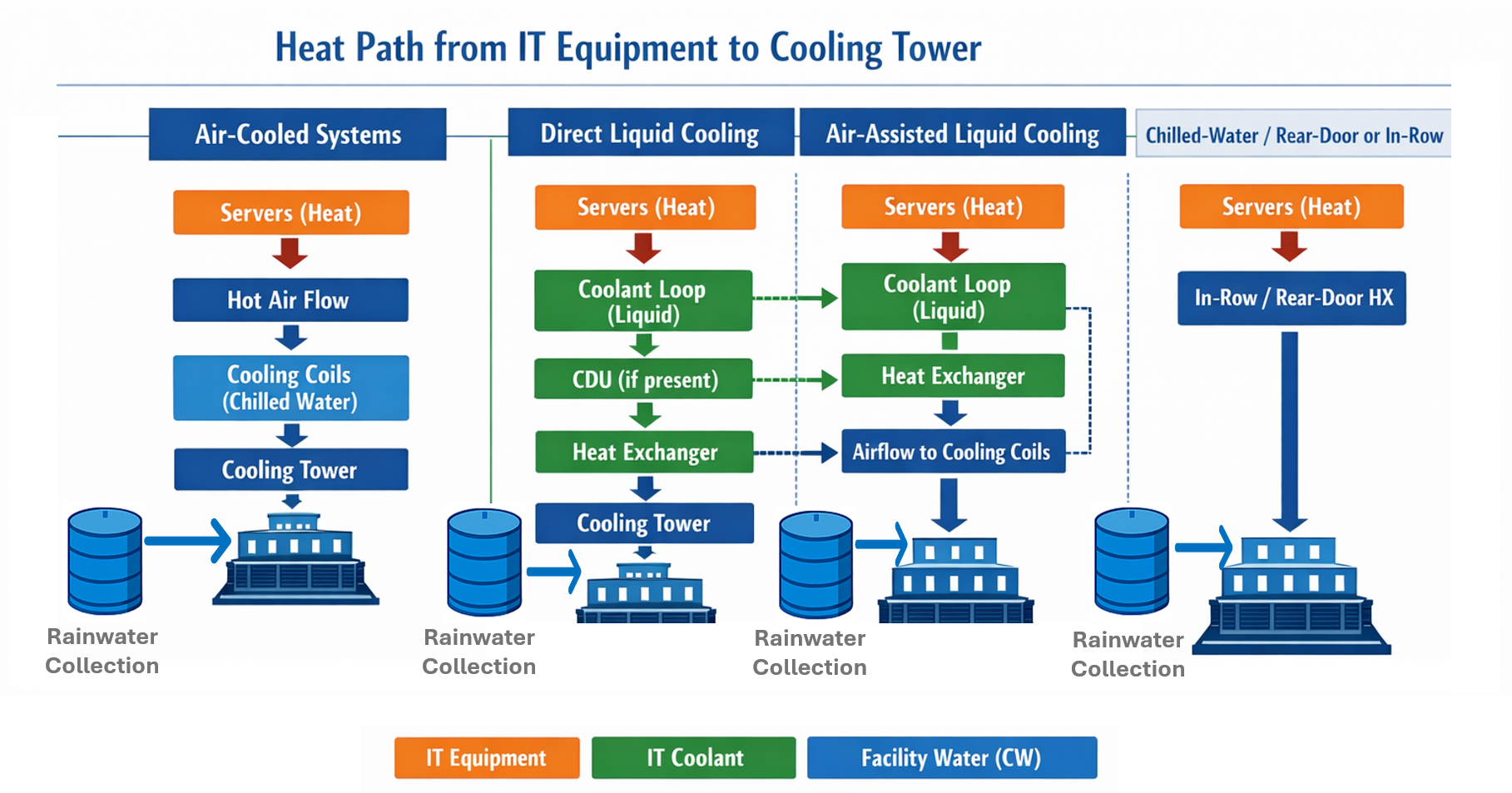
figure 1. Cooling towers can be applied as final point heat rejection in various types of cooling system architechtures used by data centers. However, while highly energy efficient, evaporative cooling requires large volumes of water, which makes cooling towers prohibitive in some areas. rainwater collection and management systems can be highly effective at reducing municipal make-up water use.
Pros And Cons of Cooling Towers
The primary advantage of cooling towers in data center applications is their efficient heat rejection. The direct contact between water and air in a cooling tower facilitates both heat transfer and evaporation. Furthermore, the evaporation of a single pound of water releases approximately 1000 BTUs into the atmosphere, depending on the elevation. That’s a lot of cooling for the minimal energy it takes to operate a cooling tower fan.
However, cooling towers require continuous makeup water to replace water lost through evaporation, drift, and blowdown. A medium sized data center can consume up to approximately 110 million gallons per year for cooling. Large, AI-centric data centers can consume up to approximately 1.8 billion gallons per year. This makes cooling tower heat rejection environmentally prohibitive. In drought-prone areas and/or areas with high water costs cooling towers may be restricted.
One way to address the water issue is to include a rainwater collection/management system to significantly offset the need for make-up water from a municipal source.
Here is a summary of the advantages and disadvantages of colling tower heat rejection.
Cooling Tower Advantages:
• Highly efficient heat transfer thanks to direct contact between air and water, and high evaporative capacity
• Low initial equipment and installation costs compared to a closed-circuit cooling tower or evaporative condensers
• Simple design
Cooling Tower Disadvantages
High water consumption
Cooling tower water is vulnerable to contamination
Requires filtration and water treatment chemicals
Operating costs may increase over time due to scale build-up on heat transfer surfaces if the tower isn’t cleaned and serviced regularly
Open Loop Cooling Tower Optimization
Despite the disadvantages, cooling towers will continue to play a role in some data centers, although that role is likely to diminish. New and existing applications can optimize cooling tower performance with the following strategies:
Integrate a Water-side Economizer. Add a pre-cooling water coil to the computer room air conditioning (CRAC) unit upstream of the evaporator coil. When ambient air permits, use the cooling tower to cool condenser water by diverting it to a pre-cooling coil. This helps reduce and sometimes eliminate costly compressor-based cooling. Alternatively, a heat exchanger can be installed to operate instead of the chiller when water from the cooling tower) is cold enough to provide cooling.
Oversize the Cooling Tower. Equip an oversized cooler tower with VFD fans. Larger cooling towers and fans that operate at lower speeds are more energy efficient than smaller towers and fans. Large towers also have a closer approach to the ambient wet-bulb temperature, allowing for lower condenser water temperatures, resulting in improved chiller efficiency and/or more hours of waterside economizer operation.
Set chiller water at a higher temperature. A higher chilled water temperature (55°F or above) extends the operating hours of the water-side economizer and reduces the chiller load when economizer operation is not possible.
Optimize the Condenser Water Loop. Use a condenser water temperature reset to keep condenser water no more than 5-7°F warmer than the outdoor wet-bulb temperature, rather than maintaining a fixed temperature, such as 85°F. When it’s cooler outside, the tower produces colder water, so the chiller doesn’t have to work as hard. Outdoor reset significantly improves the efficiency of variable speed chillers.
Next up, we will explore the various types of closed-loop heat rejection, along with emerging closed-loop technologies.