Fire Pumps for Sprinkler Systems Part 2: What Type of Pump Do You Need?
/By Wade Laughon
Different buildings have different requirements when it comes to fire pumps. The type of fire pump you choose depends on several factors, including the source, how much space you have, whether it’s a new construction or retrofit, and the size and structure of the building.
Fire pumps come in three primary designs: vertical inline, horizontal split-case, and vertical turbine. Each of these varies significantly in design, operation, installation, and compliance with NFPA 20.
Vertical Inline Pumps
Vertical inline pumps are close coupled with the motor installed vertically above a horizontally aligned suction and discharge. They can be mounted directly to the floor without a concrete base. Because of this vertical design, they need up to 30% less space than end-suction pumps of similar capacity, making them ideal for applications with limited floor space, especially retrofits. These pumps offer light to medium-large capacity service, topping out at about 1000 GPM at 184 psi.
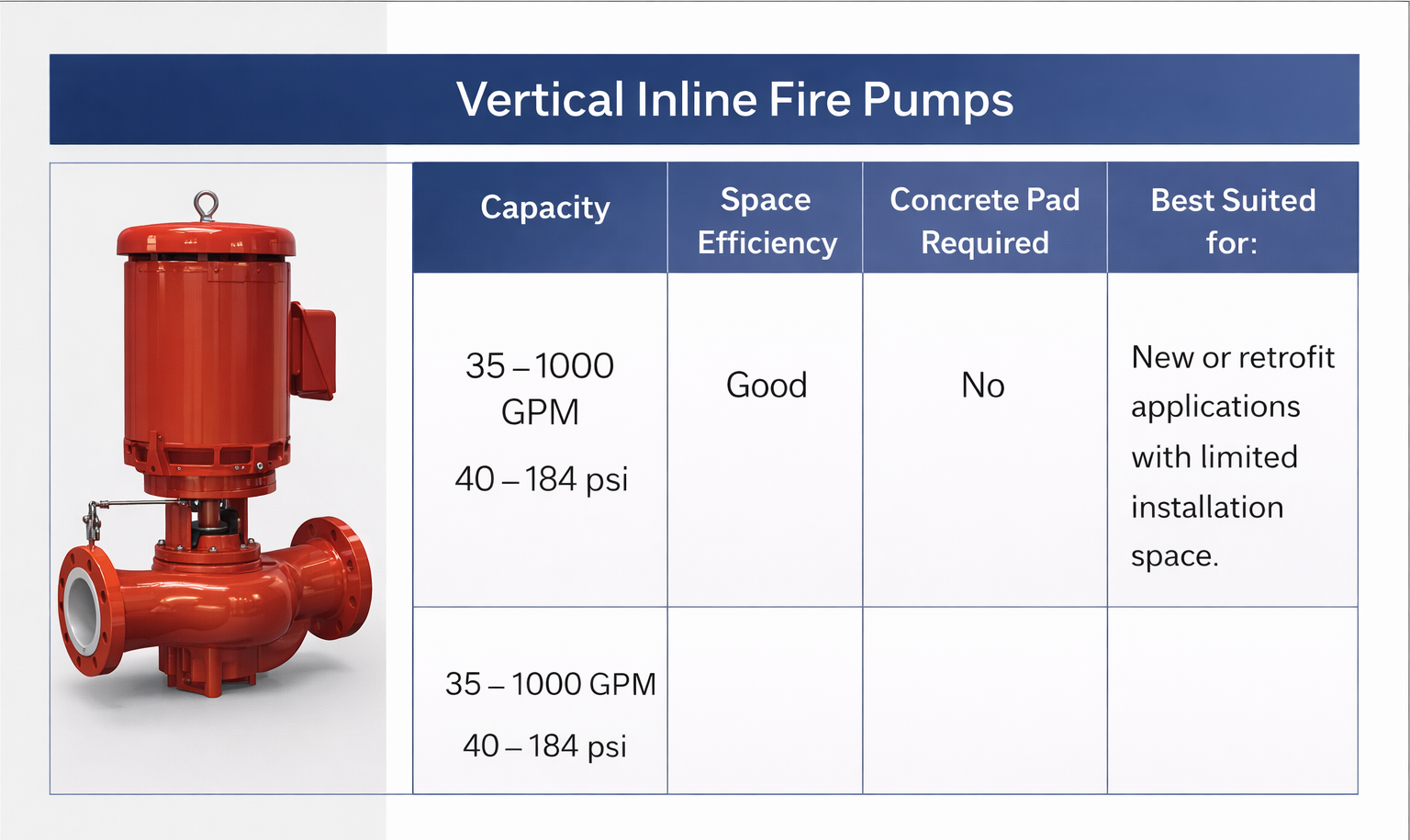
Vertical inline pumps are also easy to maintain, thanks to a self-venting design with no pump bearings and a single stuffing box that reduces leakage by 50%. Larger sizes will require lifting gear to remove the motor from the volute to access the impeller and seal.
Horizontal Split-Case Pumps
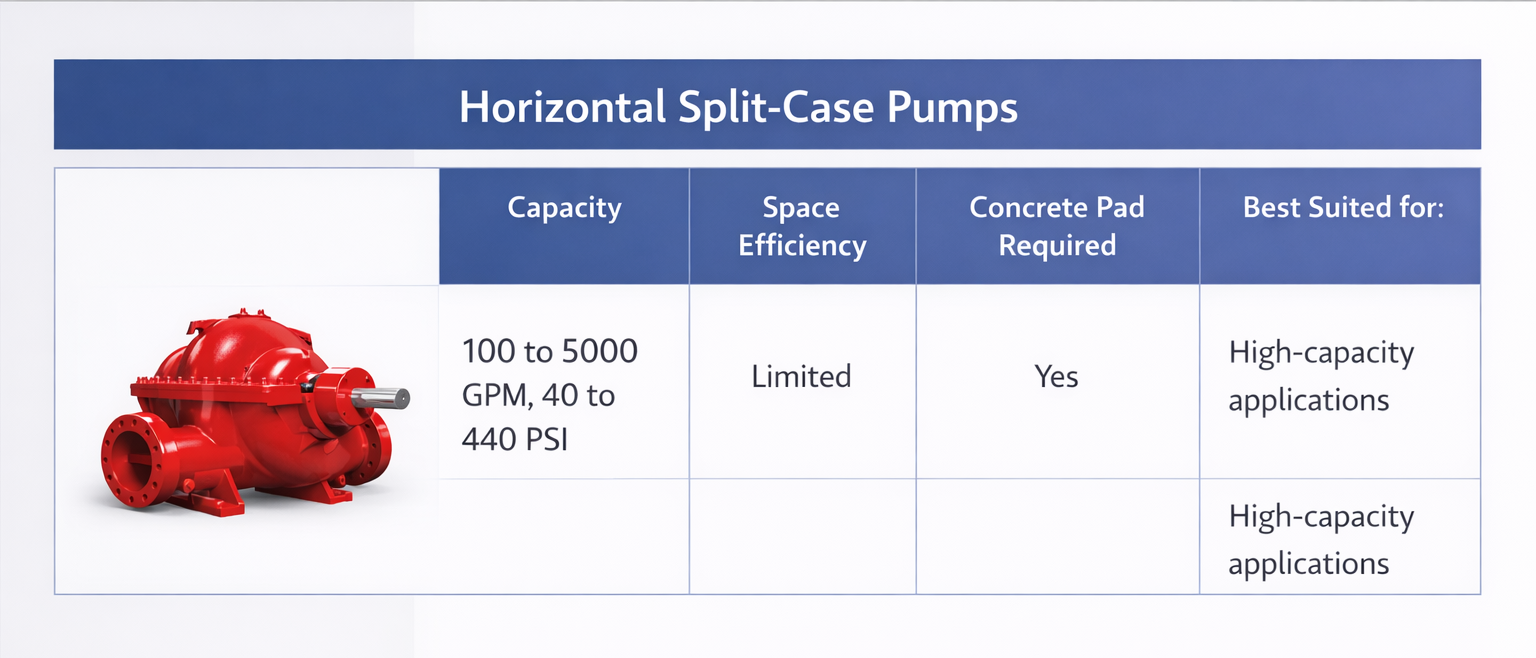
Horizontal split-case pumps are generally favored for larger commercial and industrial applications because of their high-capacity ranges. These floor-mounted pumps can be configured for clockwise or counterclockwise rotation. The upper half of casing can be removed for servicing without disturbing the piping. They can handle capacities up to 5000 GPM.
Vertical Turbine Pumps
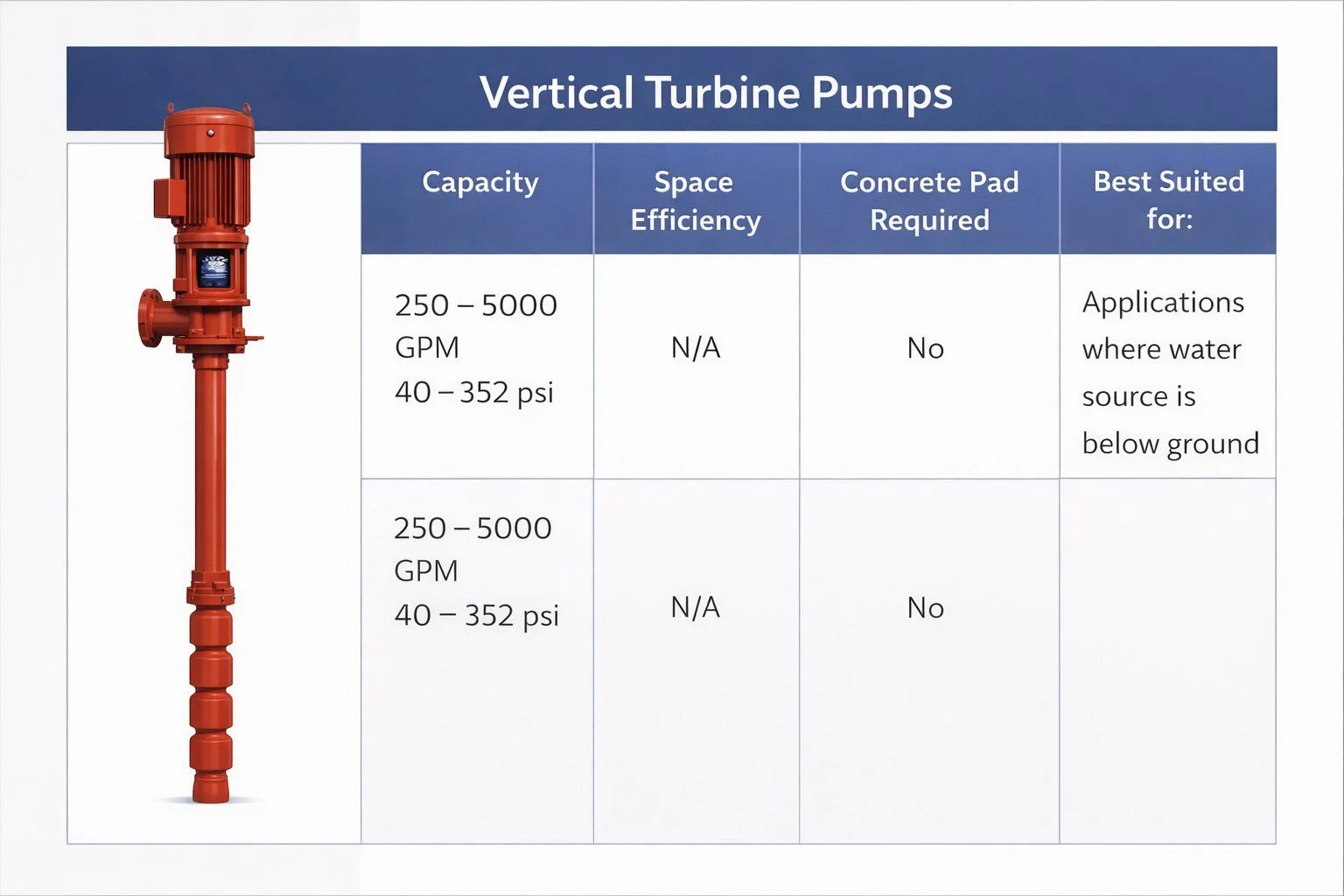
If a building’s water source is below ground level, (e.g., a reservoir, lake, or well) a vertical turbine fire pump is required. These pumps have a motor that is located above the ground and coupled with a shaft and impeller assembly that is submerged into the water source. They are commonly used in municipal systems and rural settings. Their flow and head capacities are similar to horizontal split-case pumps.
Drives & Motors
Per NFPA 20, fire pumps must be specifically labeled for Fire Pump Service, signifying that the pump has been tested and certified by UL (Underwriters Laboratories) and/or FM Global. NFPA also says that the maximum pump horsepower cannot exceed the motor’s nameplate rating by more than 15%. A back-up power source, such as a dual utility power source or emergency generator must be provided for electric fire pumps used in critical applications.
Wade Laughon has 39 years of experience in fire pump sales and application. He started the fire pump division at JMP when he came to work for the company in 1989.