Energy Efficient Hot Water Boiler Plant Design Part 1: Combustion Process and Combustion Efficiency
/Understanding Primary Secondary Pumping Part 4: “What happens when...?”
/By Chris Edmondson
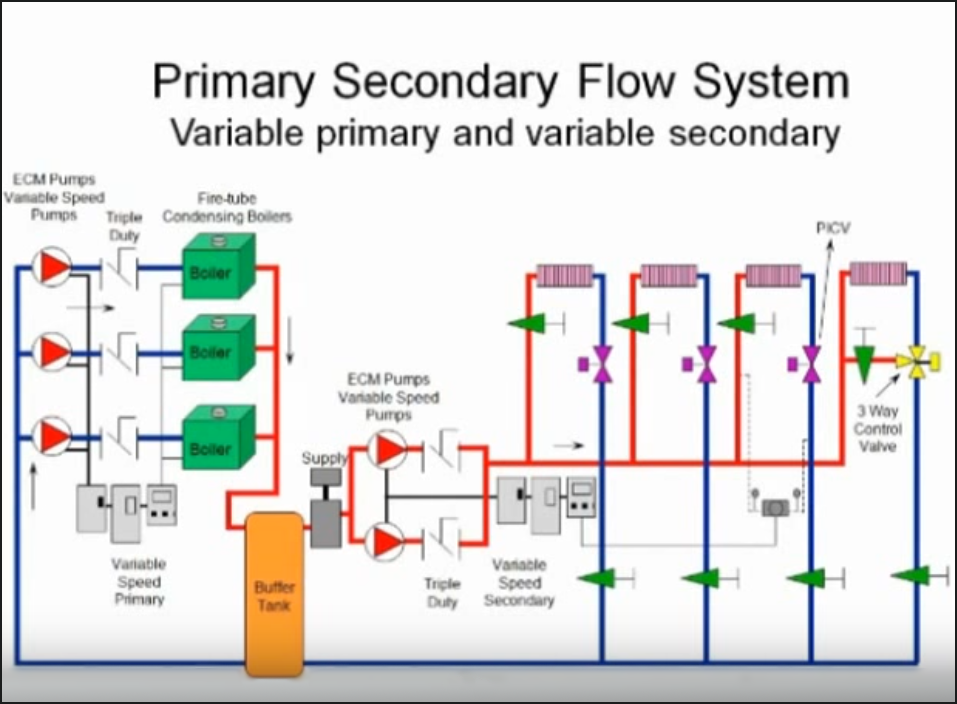
Now that we know what happens when we vary flows and mix temperatures in a primary secondary pumping system, let’s explore these theories in some more realistic scenarios.
As discussed in a previous blogs, when it comes to primary secondary systems, one of three flow patterns is always in occurrence:
Read MoreAir Management and Pressurization Part 5: Is It A Compression Tank or an Expansion Tank?
/By Chad Edmondson
As we bring our first series about air management in a hydronic system to a close, we’re going to revisit tanks – not what they do (we’ve already covered that) but what we call them. Specifically, we want to address whether or not there is a difference between what some industry professionals call an “expansion tank” and what others call a “compression tank.”
Air Management and Pressurization Part 4: Expansion Tank Sizing
/By Chad Edmonson
Properly sized expansion tanks (standard or bladder/diaphragm) are critical to a successful air management in a hydronic system.
Every expansion tank manufacturer has a written form that provides the steps and calculations for sizing an expansion tank. Most, if not all, have developed software that does the work for you. Bell & Gossett has a great one, ESP-Plus which can be downloaded here. But regardless of whether you use software or charts and longhand calculations to size an expansion tank, there are a few pieces of information you’re going to have to have either way. These key values are: